Posted in
Microsoft unveils energy management software
 June 26th, 2009
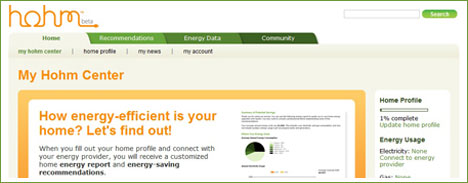
Google has been releasing information on their smart meter management software called PowerMeter little by little, but we’ve yet to see a fully-completed product. Microsoft is hoping to steal some of their thunder by releasing a beta version of their energy management software, Hohm, this week and, at least appearance-wise, it has Google beat.
The web-based software allows users to monitor and control their energy use by logging into the Hohm website with their Windows Live ID and zip code. Based on that information, the software makes estimates of their home energy use and allows the user to enter specific information by answering any or all of 180 questions, with each answer making the numbers more accurate.
So far the software is only available for use by a few utilities – Xcel Energy, Sacramento Municipal Utility District, Seattle City Light and Puget Sound Energy – with more in line to start using it soon. If you happen to live in one of the areas serviced by the list above, your energy use information will be even more comprehensive with historical data available from the utility.
The software will be smart meter-compatible as soon as any of its utility partners begin using them.
Eventually, the software will be used in connection with electric vehicle charging and grid demand management, but those more deluxe features will likely come with a price. Microsoft has made clear that this software is a product like any other they’ve created and as it’s further developed, cost will start being a factor. For now, at least while it’s in beta, the energy management tool is free.
via Earth2Tech
Would you pay $175 to save the climate?
June 26th, 2009

(Photo: Jaap Hart / iStockPhoto)
The questions about global warming keep evolving. In the Bush years, we were stuck on Is it real? (yes). The Obama administration has moved the question to What are we going to do about it? which has all but been answered (a cap-and-trade regulation on major polluters).
So recently, the question has become: How much will it cost?
This debate has sprung largely from a Republican misreading (why not be generous?) of an MIT study that led pundits and politicians to cry about the perils of a new energy tax that might cost American households $3,100 every year. (Though that claim has been thoroughly debunked, I seem to hear it every other Saturday in the Republican response to President Obama’s weekly address.)
The author of the MIT study puts the cost at $800, while the conservative Heritage Foundation estimated the annual cost at $1,500 and the Environmental Protection Agency estimated the cost at just $140 or lower.
Hence, the debate.
Politics being what it is, don’t expect the debate to stop just because a nonpartisan, highly trusted organization has released the definitive study. But it has.
The Congressional Budget Office has examined the costs — and rebates — being engineered into the Congressional climate solution. The result: The average household will pay about $175 a year. The richest among us will pay more, about $245, and the poorest will get rebates enough to make $40 in the bargain.
As the Washington Post puts it: The costs would result from higher prices for carbon-based fuels, offset by a complex series of tax breaks and free allowances, new technologies and behavioral changes, and impacts on corporations and their profits.
Soon enough the question being asked should change again: Are you willing to pay $175 to preserve the climate?
It might mean you pay a little more for a car or a refrigerator, for instance — as a new report makes plain the recognition that carbon dioxide and other well-known greenhouse gases aren’t the only problem. Refrigerants known as HFCs — the hydrofluorocarbons that replaced the CFCs we banned to save the ozone layer — are a growing concern.
It might mean your electricity bill is higher (which may or may not prompt you to conserve more energy to keep your monthly costs flat). It might mean that consumer goods in general cost a little more, as the cost of doing business increases. If you work in some industries, it might mean a threat to your job; if you work in others, it might mean a hiring bonanza.
So the question is: Is that level of sacrifice worth it in order to preserve a climate that has supported life as we know it?
Already, the rate of warming is speeding up beyond earlier predictions (by 2100, it will be twice as warm, globally, as previously predicted, according to one well-regarded analysis). Already, the Arctic is melting, threatening the lives of wildlife like polar bears and walruses. Already, glaciers are melting.
These are remote, leading edge indicators of the changes that are in store in real time, and in moderate latitudes. Drought, floods, strong storms, heat waves, new diseases (both for humans, and for animals and crops), increased wildfire intensity and frequency, and a host of other ills are already showing up in the U.S. and will only grow more intense with time.
So is it worth $175 a year to avert the worst?
Â
More from The Daily Green
- 15 Things You Can Do to Help the Environment
- The Clean 15: Foods With Low Pesticide Residue
- Six Eco Myths Debunked
- 11 Powerful Environmental Advertisements
- Six Safe Green Investments
Reprinted with permission of Hearst Communications, Inc
Recycle Guys – Recycled Content Products
June 26th, 2009
Author: RecycleGuys
Keywords: reduce reuse recycle school supplies rulers backpacks pencils fun kids cartoon NC education paper recycled content recycling bicycles elementary school North Carolina students Recycle Guys
Added: July 2, 2007
guitar wolf live green bay, WI 98
June 25th, 2009
Author: MrBradxx
Keywords: guitar wolf live green bay WI 98
Added: June 17, 2009
Price of printing extra pages
June 25th, 2009

How many times have you unintentionally printed out extra pages? You know, the pages that are essentially blank with maybe a line or two of meaningless text at the top. Turns out, these extra printed pages are more than just an annoyance. They also waste a staggering amount of money, not to mention paper and ink.
Consider this: An estimated 17% of the pages we print are waste. We’d save about $17.4 billion a year in office printing costs if we eliminated all that waste, according to American Forests. Â It would also save between 20 and 30 million trees.
So, what can you do?
Print preview. Sure, it takes an extra minute, but it’s the easiest way for most of us to avoid printing extra pages. You’ll save money (on paper and ink) and time (recycling and disposing of wasted paper).
Print management tools. Business owners and consumers who need some extra help can use software to help cut down on printing costs. Here are a couple of options:
GreenPrint searches your document and highlights pages that are considered waste, allows you to remove text or images from previewed pages, and gives you the option to create a PDF file that you can save on your computer instead of (or in addition to) printing out. You can also keep tabs on how much money you save per printing job or over time.
There are three versions of the software, starting with a free one for consumers who use Windows. Consumers who have a Mac or want additional printing features will pay $29 for the Home Premium edition. And there’s another version for businesses.
FinePrint Software has three different products to help you delete unwanted pages, print multiple pages on one sheet, and more. Each product has different features, although there is some overlap, so you’ll have to decide what’s most important to you. Sign up for a free trial before laying out the $49.95 or $99.95.
Here are some super-easy ways to save money on printing:
Print on both sides of the paper. Set your printer to automatically print on both sides of a sheet of paper and you’ll reduce your paper use by about 10% or more. Check to see if your printer has a duplex printing option, and, if does, turn it on. Learn how to enable it.
Want to do more? Ask you office manager to set up duplexing for all the printers in your office. An added incentive: During a 5-week test of double-sided printing, Citigroup saved about $98,000.
Change paper margins. The standard margins in Microsoft Word are 1 inch at the top and 1 ¼ inches on the left and right, but most of us can get along just fine with smaller margins.
If you change the margins to 0.75 all around, you’ll use about 5% less paper, according to a study done by the Penn State State Green Destiny Council. Get directions for changing the margins in Word. And, of course, you’ll make an even greater impact if you could convince your office manager to do the same.
Â
Yahoo! Green is now on Twitter! Follow us at http://twitter.com/YahooGreen.
Environmental journalist Lori Bongiorno shares green-living tips and product reviews with Yahoo! Green’s users. Send Lori a question or suggestion for potential use in a future column. Her book, Green Greener Greenest: A Practical Guide to Making Eco-smart Choices a Part of Your Life is available on Yahoo! Shopping and Amazon.com.
Global warming impacts
June 25th, 2009
Global warming is the rise in the average temperature of the Earth’s atmosphere and the increase of the ocean’s sea level. The polar ice caps are slowly melting due to the high temperature of the atmosphere. Global warming has a significant impact on our environments condition. Our everyday life is also greatly affected by this phenomenon. Countries all over the world are taking considerable measures to lessen the global warming impacts.
Global warming is putting animal and plant life under great risks. A couple of animal species have already become extinct due to this drastic change of the Earth’s climate. Examples of these extinct species are the golden toad and harlequin frog which used be found in Costa Rica. A lot more species of animals are under threat of extinction because their natural habitats are being wiped out because of the effect of global warming on our environment.
Ecosystems are seriously being affected by global warming. These ecological systems, such as coral reefs, may suffer severe changes that could ultimately be irreversible. One factor of global warming that is affecting the ecosystems is the melting of the glaciers in the Polar Regions. This would be a great loss to our environment. People who want to protect these ecosystems are generally helpless to stop this drastic change. If this changes goes on without proper actions being taken, global extinction will not be impossible in the distant future.
Seasons are also generally affected by global warming, because of the fast change in temperature. The lengths of our seasons may vary, which disrupts the livelihood of man and animals alike. Shorter winters and longer summers may be experienced with extreme temperature levels. Plant life is also disrupted by these unprecedented seasonal changes.
Heat waves across the globe are not uncommon because of the global warming impacts. People are gravely suffering from these conditions. Energy consumptions used for cooling purposes is at an all time high. The already dry places in Earth have become even drier and hotter. These extremes in the temperature has caused outbreaks in heat related sickness or diseases.
Significant research and studies are taken by the world’s governments to learn more about global warming. With more knowledge about this phenomenon, proper measures or actions can be taking in lessening or preventing the global warming impacts. People also need to be constantly educated on the facts of global warming and how it can be prevented. They must be aware about the causes of effects of global warming.